The Pause Is Part of the Performance
The pause in performance can build expectation, sharpen a gesture, or loosen a scene. Shape its duration with clear cues rather than guesswork.
The most common mistake with a pause in performance is to treat it as a blank between lines, then fill it as soon as the silence feels awkward. That can cost a scene its pressure, its tenderness, or the audience’s chance to notice what has just changed. A pause is not one fixed length or effect; it is a choice about what performers and spectators are asked to wait for.
To shape that choice, begin with the scene’s action rather than a stopwatch. Decide what is happening during the silence, give the performers a cue they can share, and try the duration in context. The useful question is not “How long should this pause be?” but “What does this pause allow the audience to expect, see, or reconsider?”
Locate the change
Choose a precise point in the scene where speech stops. It might come after a question that receives no answer, after a character sees an object, or before someone crosses a room. The pause becomes legible when the audience can sense that something has prompted it.
Mark the point in the script or score, but do not assume punctuation can carry the whole instruction. A period may mean a clean stop in one scene and a held thought in another. Write a brief action beside the mark: “waits for the reply,” “keeps looking at the door,” or “lets the laugh fade.” This names what continues while the words have stopped.
Then identify whose attention governs the moment. One performer may be listening; another may be avoiding eye contact; the audience may be waiting for a visible decision. These are different kinds of attention, and they suggest different ways to hold the silence.
Name the audience’s expectation
Before choosing a duration, say what the audience is likely to expect next. A raised hand can suggest a strike, a touch, or a retreat. A chair left empty can make a return seem possible. The pause gains shape from the anticipated event, even if that event never arrives.
Use a plain sentence to describe the expectation: “The audience waits for her to answer,” or “The audience thinks he may open the letter.” If you cannot name what is being awaited, the silence may be functioning only as an interval. That may still be useful, but it is a different intention from suspense or hesitation.
Now decide whether the pause should fulfill, delay, or redirect that expectation. A brief hold followed by an answer may make the answer feel deliberate. A longer hold can make the question itself seem to change. An unexpected action—a character folding the letter instead of opening it—can turn waiting into a new event.
Choose a visible cue
Performers need a way to enter and leave the pause that does not depend on guessing how the room feels. A cue can be a shift in gaze, a breath, the sound of an object being set down, or a partner’s completed movement. Choose something the performers can perceive consistently and that belongs to the scene.
A cue is not a mechanical signal to freeze. It gives the performers a shared reference point while leaving room for live attention. If the cue is a glance toward the doorway, the actor can keep looking rather than counting silently. The gaze remains part of the action, and the other performer can respond to it.
Be careful with cues that are too subtle to register from the playing space or too dependent on lighting and sound conditions. A tiny finger movement may be clear in rehearsal and invisible from the back of a room. A sound cue may be masked by audience response. The most dependable cue is often a change in the partner’s body or focus that is already motivated by the scene.
Set a playable duration
Try the pause once at the shortest duration that still lets the audience register the change. Then try a more extended hold, keeping the same action and cue. Do not rush to choose the version that feels most dramatic to the performers; an audience may read a restrained pause more clearly than a visibly strained one.
During rehearsal, notice what changes as the hold grows. Does the listener become more alert? Does the room begin to anticipate a different response? Does the performer’s attention remain active, or do they start waiting for the next line as if outside the scene? A duration is playable when the performers can sustain the action without pretending that nothing is happening.
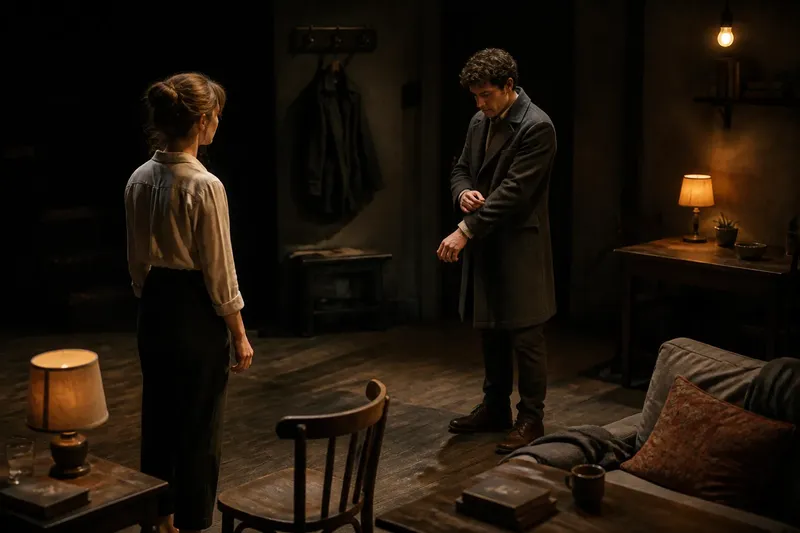
Say you are staging an invented scene in which one character asks, “Are you coming?” The other has already put on a coat but has not reached for the door. You could cue the pause when the questioner looks at the coat. If the silent character then adjusts a loose sleeve and meets the questioner’s eyes, the audience may read a struggle over whether to leave; if the actor simply holds a fixed stare, the same time may read as a challenge. The observable difference is not the number of seconds but the action that occupies them.
Keep a rough timing note if it helps performers reproduce a rhythm, but treat it as a rehearsal aid, not a universal rule. A pause may feel different after a line delivered with urgency than after one spoken softly. The scene’s preceding pace, the performers’ breath, and the audience’s response all affect how long the silence seems.
Read the room’s response
Try the scene in the space where it will be performed, if possible. A close studio audience may notice a small change in expression; a larger room may need a clearer shift in posture. This does not mean enlarging every gesture. It means checking whether the intended action can be read from the seats that matter.
Invite a few observers to describe what they thought was happening during the pause, rather than asking only whether they liked it. If one person reads reluctance and another reads anger, that difference may be productive. If nobody notices the coat, gaze, or unanswered question that was meant to organize the moment, the cue may need to become more visible.
Audience laughter or a spontaneous reaction can alter the available silence. The performers can allow the response to settle when it is part of the scene’s rhythm, or continue once the next action is clear. Agree in advance which cue takes priority: a partner’s movement, the end of laughter, or a practical sound such as a door closing. This gives the scene flexibility without making its timing arbitrary.
Questions about pauses?
How do you write a pause in a script?
Mark the location and describe the action or expectation that continues, rather than relying only on a label such as “beat.” A short cue like “listens for an answer” gives the performer something playable and gives later collaborators a reason for the silence.
Should actors count during a pause?
Counting can help establish a first rehearsal rhythm, especially when a transition needs coordination. In performance, a cue connected to attention or movement often keeps the moment more responsive than a private count.
What if a pause feels awkward?
Ask whether the performer is actively listening, deciding, watching, or withholding something. If no action is present, revise the intention before shortening the silence; if the action is clear but the audience cannot perceive it, strengthen the cue.
Can a pause be too long?
It can outlast the action or expectation that gives it meaning, but there is no single duration that crosses that line in every scene. Watch for a specific sign: the performer has completed the intended action, the audience has received the information, and nothing new is developing.
Keep only useful precision
After trying the pause in context, choose a version that serves the scene and tell the performers what must remain true: what they are attending to, what cue releases the next action, and whether audience response can extend the hold. Leave room for small variation where the scene can absorb it. A rigid count may be less reliable than a clear shared event.
It is not worth the effort to debate an exact duration in isolation, rehearse a silence without the lines and movements around it, or add a symbolic gesture solely to make the pause look important. Those refinements consume attention without clarifying the scene. Keep the ones that change what the audience can perceive.
The pause in performance earns its place when its duration lets an audience experience a particular expectation, not merely notice that nobody is speaking. In the next rehearsal, preserve one observable action inside the silence and one cue that ends it. That is enough structure to make the moment deliberate while leaving its timing open to the people sharing the room.