Carving or Building: Two Routes to a Small Sculpture
Carving or building a small sculpture changes how you plan and revise. Compare soap, clay, and cardboard to choose a beginner-friendly approach.
The common mistake in carving or building a small sculpture is choosing a material before deciding how you want to revise. That can cost you time spent forcing a process to suit an idea: carving preserves what remains, while building lets you rearrange parts. Start with the kind of decision you want to make, then choose the material that supports it.
Both approaches can produce a modest sculpture from accessible materials. Their differences show up in the working rhythm: removal is irreversible, while assembled parts can often remain movable. Neither method is inherently more disciplined or expressive.
Two kinds of planning
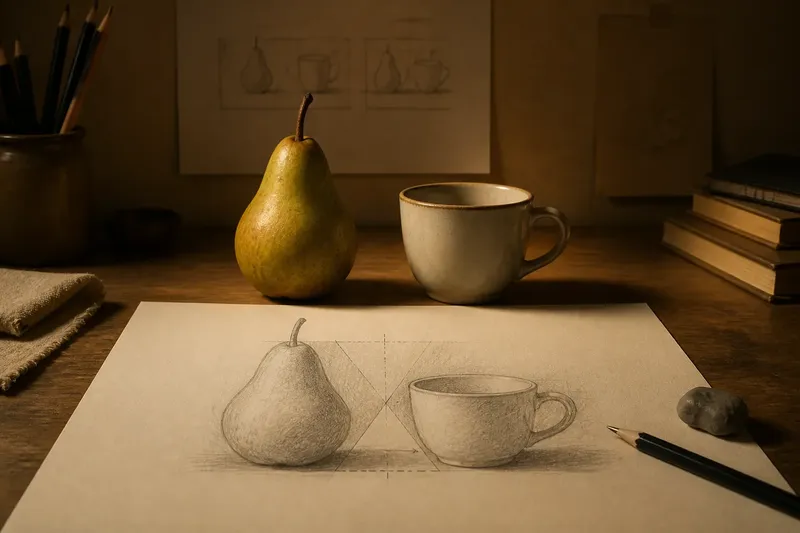
Subtractive carving begins with a block, bar, or other solid mass. You decide what should remain, then remove material around it. A sketch or a few reference views can help clarify the silhouette, but the object itself gives you direct information as you work.
Additive construction begins with separate pieces or a soft material that can be gathered, joined, or pressed into shape. You make a form by arranging relationships: a wide base under a narrow neck, folded pieces in a row, or a curved part attached at an angle. A rough mock-up can suggest a direction without dictating the final arrangement.
That difference changes what planning requires. A carver benefits from identifying the main silhouette and the areas that must stay connected before cutting. A builder can begin with a simple structure and decide what to add after seeing how the parts meet.
Carving with soap
Soap offers a beginner a solid, approachable material with a clear boundary: every piece removed is gone from the sculpture. A plain bar can become an abstract figure, a rounded animal-like form, or a shape built around a single curve. Its proportions suggest possibilities, but you need not preserve the original outline.
Use a blunt modeling tool or a plastic craft knife intended for soft material, and keep the concept broad. One dominant curve and a stable base leave room to discover the form without preserving many thin projections. Marking an outline on more than one side can help you notice if the front view is changing while the side remains bulky.
Soap dust and small chips can obscure the surface. Brush them away with a soft brush and turn the piece so your next decision responds to its actual shape. Avoid forcing a deep cut; a sequence of small removals is easier to judge.
Revision in carving means adjusting what remains. If a curve looks heavy, soften its neighboring planes or reduce a nearby mass. Since you cannot restore a removed corner, leave extra material until the surrounding form becomes legible.
Choose this route if you enjoy concentrating on a single mass and can accept that revision means redirection, not restoration. It suits compact forms better than designs dependent on delicate extensions.
Building with clay
Air-dry clay provides a contrast: you can press, join, and reshape it while it remains workable, subject to the product’s directions. A small sculpture might combine a base with a few attached coils, or gather rounded pieces into a cluster. The material invites you to think in volumes and connections.
Building lets you move or reshape parts before they set. If an upright element feels too central, shift it; if a join looks abrupt, blend or reinforce it while the clay is workable. This flexibility does not remove planning. It shifts the question from what to preserve to how the parts support one another.
Consider the sculpture’s balance as you add to it. A top-heavy-looking form on a narrow base may seem unstable, even if it stands upright. A broader base, a lower visual center, or a more open arrangement can change that impression without extra surface ornament.
Clay suits someone who likes touching, adjusting, and reconsidering a form as it develops. Coils, pressed seams, and joins can remain visible as part of the object’s character rather than being hidden.
Clay’s flexibility has a limit. As it dries or stiffens, repeated handling can roughen the surface and make joins less cooperative. Follow the maker’s instructions for working and drying, and plan around the material’s behavior rather than assuming it will remain equally pliable.
Building with cardboard
Cardboard construction offers an additive path based on planes, folds, and connections rather than soft mass. A small sculpture can grow from cut shapes, folded strips, or layers joined with paper tape. Visible edges suit geometric, architectural, or deliberately rough forms better than imitations of smooth organic objects.
Test the silhouette with separate pieces before committing to an arrangement. Hold a folded strip against a base, rotate it, and observe how its shadow and the surrounding gaps change. The sculpture can feel open or crowded even when the pieces stay the same.
For a beginner, paper tape can make temporary joints that are easy to reposition. Once the arrangement feels coherent, more permanent joining may make sense; choose materials and adhesives for the setting and follow their labels. There is little benefit in hiding every seam: a clean, intentional join may be more convincing than a heavily covered one.
This approach suits someone who likes arranging components, working with straight edges, and seeing how a flat sheet becomes a spatial form. It is less natural for a design whose appeal depends on uninterrupted, rounded surfaces.
Choose by revision
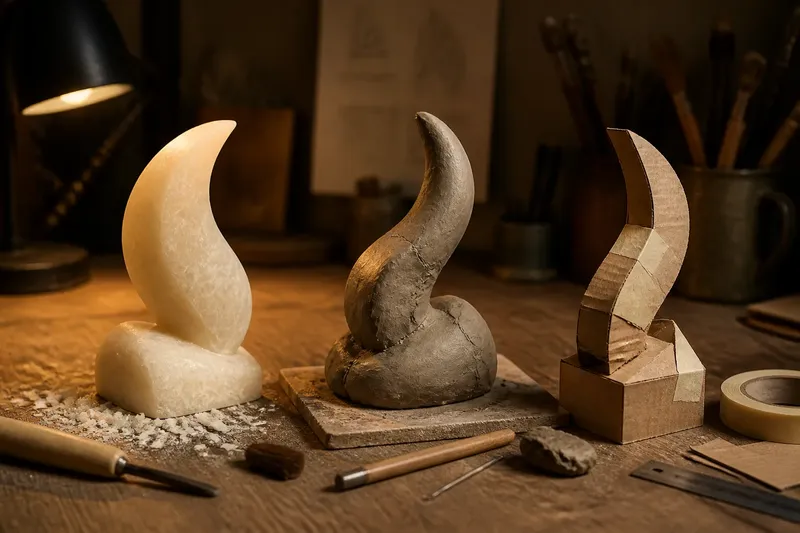
Imagine you want a small abstract sculpture from a compact starting point, with one rising curve and a stable base. You have a plain soap bar, a lump of air-dry clay, and a piece of cardboard. First, you mark the curve on two faces of the soap and remove only the outer corners; the resulting continuous mass lets you refine the contour from several angles, but the removed corners cannot return. Next, you form a clay base and add a curved coil; if the curve looks misplaced, you shift it while workable, though the joins remain visible. Finally, you fold the cardboard into a base and upright curve; rotating the pieces changes the gaps and shadows, but the form reads as angular rather than continuous. The choice depends on whether you value a unified mass, adjustable joins, or visible planes more.
Use these observations to decide:
- Check the intended form: if it depends on one continuous mass, choose soap; if it depends on separate connections, choose clay or cardboard.
- Check your preferred revision: if removing material and adapting to what remains sounds right, carve soap; otherwise, build with clay or cardboard.
- Check the surface language: if you want rounded volumes, choose clay; if you want visible planes and edges, choose cardboard.
- Check whether you need a stable, compact silhouette: if so, start with a soap bar and leave extra material around the contour; if the design needs projecting parts, test a clay or cardboard construction instead.
- Check whether the main uncertainty is proportion or balance: if it is, make a rough cardboard mock-up before refining the final material; if it is surface finish, begin with a small material sample instead.
- Check whether parts need to move during composition: if they do, use temporary paper-tape joints for cardboard or keep clay parts workable; if they do not, commit to a joined arrangement once its silhouette reads clearly.
Detailed renderings of every side are not worth the effort at the outset of a simple exploratory sculpture. A rough silhouette or a few marks can answer the practical question without turning the exercise into a plan you feel obliged to obey.
Questions before starting?
Which approach is easiest for a beginner?
It depends on whether careful, incremental removal or shaping and joining feels more intuitive to you. Soap keeps the form unified, while clay and cardboard make assembly visible; choose the process whose revisions sound more appealing.
Can a carved sculpture be revised?
Yes, but revision means changing the remaining form rather than replacing what was removed. You can soften a transition, adjust a neighboring plane, or let an unexpected contour guide the design in a new direction.
When should I use a mock-up?
Use one when you are unsure about the silhouette, the direction of a major projection, or whether the base and upper form feel balanced. A rough paper or cardboard study can clarify those relationships before you refine a clay or soap surface.
How do I choose between clay and cardboard?
Choose clay for rounded, continuous volumes and joins that can be reshaped while workable. Choose cardboard for angular planes, folds, and deliberately visible construction.
Let the material decide
For a first small sculpture, choose a material that makes the next decision visible. A block asks what can be removed without losing the form; clay asks how a volume can be shaped or joined; cardboard asks how planes and gaps can organize space.
Carving or building a small sculpture is ultimately a choice about the kind of revision you want available. If you prefer responding to a single mass, begin with soap. If you want parts to remain adjustable, begin with clay or cardboard, then let their surfaces and joins contribute to the idea rather than treating them as flaws.